Partners and supporters







Lotus Matter · engineered sorbents · modular capture system
A durable carbon capture particle, and the capture system built around it, for every industry that runs hot.
of a plant's CO₂ captured, built up one smaller capture unit at a time.
sorbent consumed than conventional limestone-based capture.
Patent filed and wholly owned. Innovate UK funded.
Partners and supporters
How it works
Most capture technology asks a plant to cool its gas, bolt on a chemical plant the size of the kiln and commit to it all at once. We start from the material instead, and design everything else around how it behaves.
Calcium-based capture is the best-suited chemistry for hot industrial gas, and it has never gone commercial because the limestone it runs on sinters shut and has to be replaced continuously. We engineer a composite particle that holds its structure instead, and supply it as a consumable.
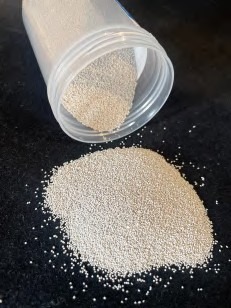
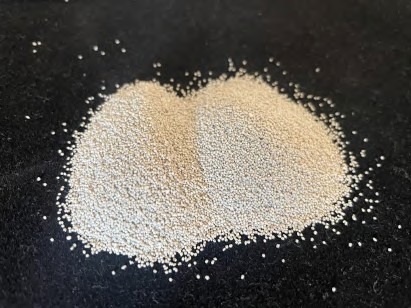
Built to resist the sintering and wear that make limestone crumble, so each particle keeps capturing for longer. In cycling tests to date it retains 15–20% more capture capacity. That means less sorbent bought, less purged and a lower cost per tonne captured.
Spent particles are not a waste stream. Their chemistry is designed to go back into the host process as raw feed. In a cement plant they go straight into the kiln, so the sorbent itself is part of a closed loop.
An optical tag engineered into every batch lets capture performance be read from the material itself. Our monitoring software, now in development, turns those readings into continuous, auditable capture data instead of periodic sampling.
Regenerated particles leave the calciner hot. Held in a store, they can release high-grade heat when the plant needs it, a second output alongside capture. A design feature of the system, not yet a tested claim.
Our particle works at the temperature an industrial process already runs at, instead of asking the plant to cool its flue gas and pay for the privilege twice.
Our particles circulate between two hot vessels beside the plant. The kiln line itself is never touched.
Flue gas meets the particles. CO₂ binds to them and the gas leaves clean, while the reaction gives off heat.
The loaded particles are heated, let go of a pure CO₂ stream ready for storage or use, and come out regenerated.
Regenerated particles go round again carrying useful heat. Worn ones are purged into the kiln as raw feed, so nothing is wasted.
Instead of one enormous capture plant, the system is assembled from standard factory-built units on a shared spine. The first decision is a fraction of the size, each unit earns before the next is bought, and a plant adds capacity as free allowances phase out.
A plant and a grant can carry unit one, instead of committing to a full-scale build before anything is proven.
Repeating a shop-built unit sidesteps scaling two coupled reactors to full cement size in a single leap.
The commercial pilots are built as the first unit and stay with the host as a working asset.
Compact, fast reactors need a particle that survives them. Natural limestone breaks down too quickly to run this way.
Figures are from our own system model for a one-million-tonne clinker plant. Detailed economics are shared with partners and investors under NDA.
Where we fit
The particle is reactor-agnostic and sector-agnostic. The chemistry does not care what burns upstream. We are proving it where the pull is strongest, and labelling honestly how far along each one is.
Kiln gas, 15–25% CO₂.
Capture units bolt on at the end of the line, the kiln is untouched, and worn particles return as kiln feed.
Entry marketEvery tonne is a removal.
No kiln to absorb worn sorbent, so durability pays most here, and the existing steam turbine takes the recovered heat.
Entry marketCalcium-based DAC plants.
Several DAC developers run on calcium sorbents that wear out. We sell them particles; they keep their plant.
Sorbent saleAbout half biogenic CO₂.
Enters the UK emissions trading scheme from 2028. Needs chlorine tolerance, which is still to test.
NextBlast-furnace gas, 20–27% CO₂.
Rich, hot, dusty gas suits the chemistry, and worn particles can replace flux lime.
NextLime kilns, kraft mills.
A good fit for kilns that do not want an oxyfuel rebuild, at smaller or more remote sites.
LaterWhy now
Heavy industry's emissions can't be designed away. Across our four markets, policy now puts a cost on them, and a new kind of buyer is paying for the alternative.
Around two-thirds of a cement plant's emissions come from the reaction itself. Switch every kiln to renewable power and most of them remain. Capture is the only way to deal with them.
Policy levers in our markets
Free emissions allowances for heavy industry are being withdrawn, and since 2026 importers pay for the carbon in cement and steel through CBAM. A proposal to bring permanent removals into the ETS is now under negotiation.
A UK carbon border adjustment covering cement starts in January 2027, the UK ETS extends to energy-from-waste in 2028, and long-term government funding is backing industrial CCUS clusters.
The 45Q tax credit, retained and strengthened in 2025, pays up to $85 for each tonne captured at an industrial site and stored, and now the same for CO₂ that is put to use.
India's Carbon Credit Trading Scheme sets binding emission-intensity targets for cement and other heavy sectors from 2025–26. Plants that beat their target earn credits to sell; those that miss must buy them.
Hyperscalers' emissions are rising with the AI build-out, and much of their footprint sits in the concrete and steel of new data centres. They have become some of the largest buyers of low-carbon cement and of durable carbon removal. These are the two markets our particle serves: cleaner cement through capture at the kiln, and permanent removals from biomass plants.
Team
A materials company needs a materials scientist and someone who can get the material into a plant. That is the whole thesis of how we are staffed.

CEO & Co-founder
Ten years consulting at Deloitte across India, the US and the UK, and three years in climate tech. Has founded two early-stage companies, including one with an exit.
LinkedIn ↗
CTO & Co-founder
PhD in Chemical Engineering from the University of Bath, with a background developing engineered microparticles at commercial scale. Leads formulation and process development.
LinkedIn ↗
Academic Advisor · Cranfield
Carbon capture researcher at Cranfield University, home of the UK's calcium looping pilot facility, and closely involved in validating the technology.
LinkedIn ↗
Academic Advisor · Loughborough
Particle engineering and microparticle manufacturing at Loughborough University, working with us on manufacturing method development.
LinkedIn ↗Get in touch
Cement plants in the UK, Europe and the US alone release around 200 million tonnes of CO₂ a year. If you run a cement, lime, biomass or waste-to-energy plant, build capture systems, invest in industrial decarbonisation, or need a calcium sorbent that lasts, we would like to hear from you.
Message sent
We have your note and will be in touch soon.